

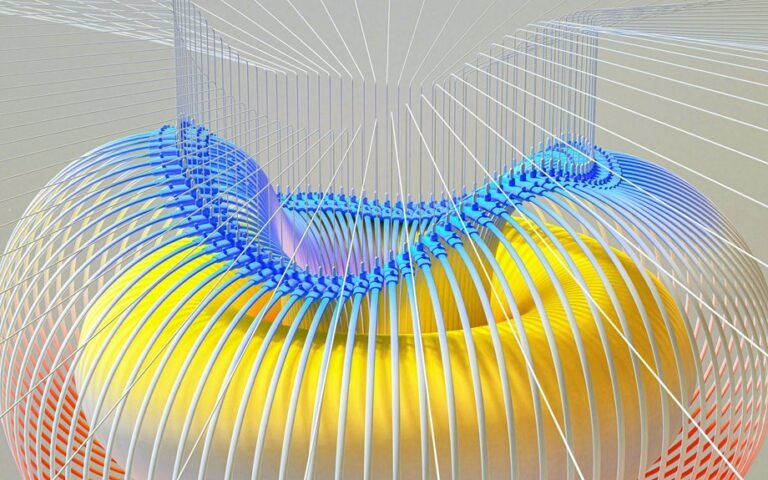
Fusion Beam 1122330027 Neural Flow proposes a framework that combines fusion beam dynamics with neural-inspired processing to optimize trajectory, energy distribution, and stability margins. It emphasizes energy-efficient confinement, adaptive sparse representations, and principled uncertainty quantification. Real-time data streams are guarded by scalable safety architectures and inline aggregation for interpretability. The approach promises robust validation from prototypes to field deployment, yet critical questions about integration, latency, and risk management remain to be settled.
What Fusion Beam Neural Flow Is: and Why It Matters
What Fusion Beam Neural Flow is: a conceptual framework that integrates fusion beam dynamics with neural-inspired processing to model and optimize high-energy beam interactions. It presents a disciplined approach to fusion optimization, mapping control signals to trajectory and energy distributions while preserving stability margins. The framework emphasizes neural control paradigms, enabling adaptive regulation, predictive tuning, and robust performance under perturbations.
Core Mechanisms: Energy-Efficient Fusion Physics Meets Neural Dynamics
Energy-efficient fusion physics relies on optimizing both the confinement of high-energy beams and the neural-inspired control signals that govern them. This synthesis aligns fusion energy with neural dynamics, exploring mechanisms where feedback, adaptation, and sparse representations enable efficient operation. Interpretability guides deployment decisions, revealing causal links between parameters and outcomes, while robustness underpins scalable, freedom-friendly performance.
Real-Time Data and Safety: Robustness and Interpretability at Scale
Real-time data streams from fusion-neural systems necessitate robust, scalable safety architectures that preserve stability under variable loads and fault conditions.
The analysis reveals an interesting tension between immediacy and interpretability, as models inline-aggregate high-velocity inputs while maintaining auditable traces.
Cross-domain robustness emerges through modular validation, dynamic anomaly detection, and principled uncertainty quantification guiding trustworthy, scalable decision-making.
From Prototypes to Deployment: Challenges, Validation, and Case Studies
From prototypes to deployment, the transition section analyzes the critical steps, constraints, and decision criteria that govern moving fusion-neural systems from laboratory validation to field-ready operation.
The discussion evaluates fusion architecture implications, deployment challenges, and validation prototypes, emphasizing rigorous risk assessment, modular integration, and scalable testing.
Two-point discussion ideas: architecture progress, deployment lessons.
Conclusion
Fusion Beam Neural Flow synthesizes energy-efficient fusion physics with neural-inspired processing to deliver robust, real-time control and interpretable uncertainty management. The approach cohesively maps control signals to trajectory and energy distributions while preserving stability margins, supported by scalable safety architectures and inline data aggregation. A hypothetical case: a pilot facility deploying adaptive confinement reduced energy losses by 12% during transient disruptions, illustrating tangible gains in reliability, efficiency, and confidence in scalable deployment.